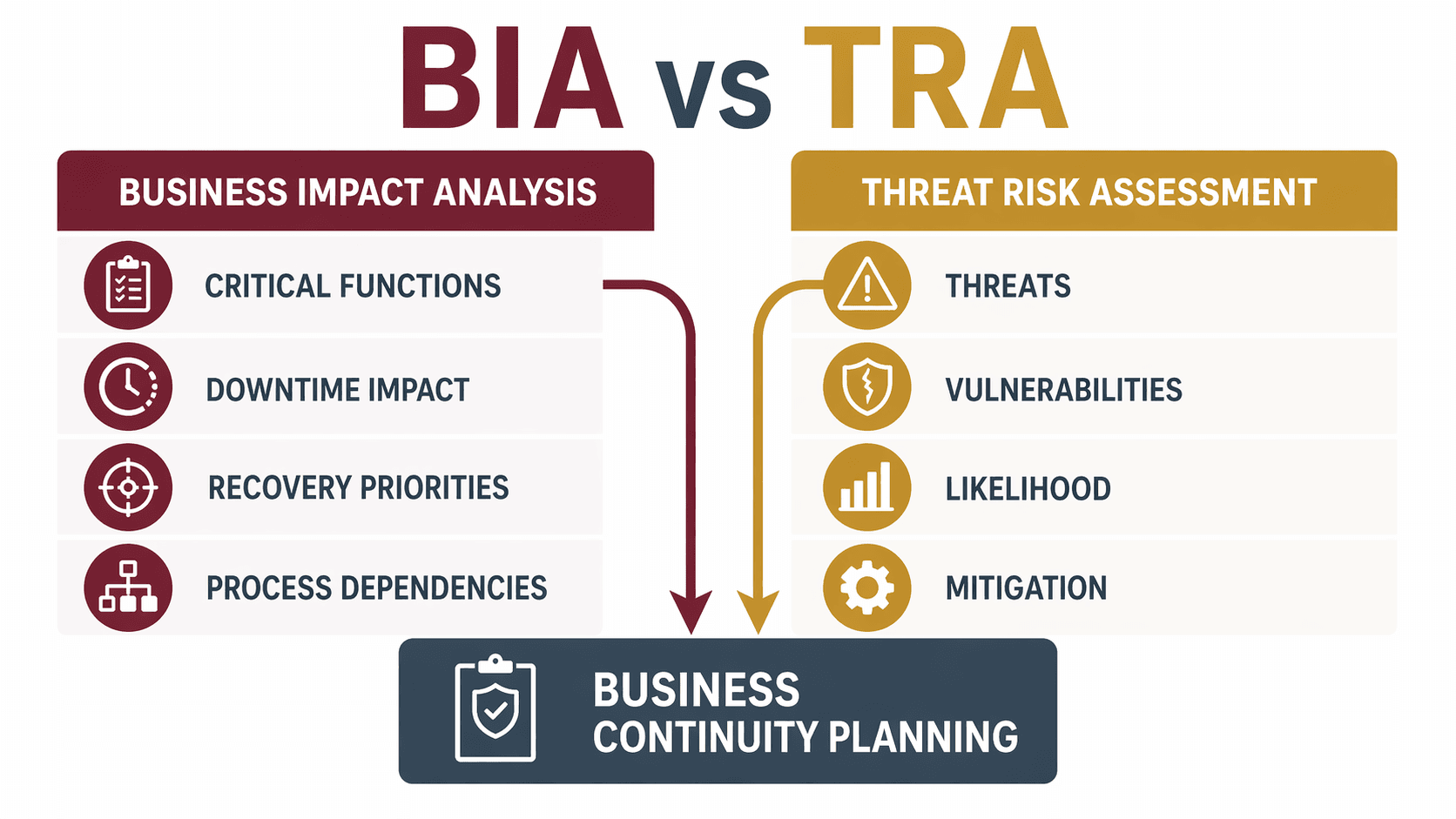
When organizations begin building a stronger business continuity program, two terms often come up early: Business Impact Analysis (BIA) and Threat Risk Assessment (TRA). They are closely related, but they are not the same thing.
A Threat Risk Assessment helps you understand what could go wrong and how likely those threats are to affect your organization. A Business Impact Analysis helps you understand what would happen to your business if critical operations were disrupted.
In short:
Both are essential, and they work best together.
If you want to manage both in a more practical way, SHIELD business continuity planning software helps teams organize their Threat Risk Assessment, Business Impact Analysis, recovery planning, and ongoing maintenance in one secure platform.
A Threat Risk Assessment identifies threats, vulnerabilities, and likelihood.
A Business Impact Analysis identifies critical functions, recovery priorities, and the consequences of downtime.
A TRA asks:
A BIA asks:
A threat risk assessment is a structured review of the threats and vulnerabilities that could affect your organization. It helps you identify risks before they turn into real disruptions.
A TRA may include:
The goal is to understand where your organization is exposed and which risks deserve the most attention.
A business impact analysis focuses on the operational consequences of disruption. It helps you identify your most important business functions and determine what happens if they are interrupted.
A BIA may include:
The goal is to prioritize recovery and make sure the organization knows what must come back first.
The simplest way to understand the difference is this:
A TRA helps you understand the cause of disruption.
A BIA helps you understand the cost of disruption.
They answer different questions, and that is why one should not replace the other.
| Dimension | Threat Risk Assessment (TRA) | Business Impact Analysis (BIA) |
| Primary focus | Threats, vulnerabilities, likelihood | Operational impact and recovery priority |
| Main question | What could go wrong? | What happens if it does? |
| Output | Risk picture and exposure areas | Critical functions and recovery priorities |
| Helps with | Prevention and mitigation | Recovery planning and continuity strategy |
| Typical inputs | Threats, assets, vulnerabilities, controls | Processes, dependencies, timelines, impacts |
| Typical result | Ranked risks and mitigation priorities | Recovery objectives and continuity priorities |
Yes.
A business continuity program is much stronger when it includes both a TRA and a BIA.
Without a TRA:
Without a BIA:
When used together, they create a much clearer picture:
That combination gives you a better foundation for planning, recovery, and testing.
In many organizations, the TRA comes first because it helps identify the disruption scenarios the business should be planning around.
Then the BIA helps measure the effect of those disruptions on critical operations.
In practice, they often inform each other:
So the answer is not always strictly one before the other. The stronger approach is to connect them and keep them aligned.
A strong business continuity plan depends on both risk visibility and recovery priorities.
The TRA helps teams:
The BIA helps teams:
Together, they support:
One of the most common continuity planning mistakes is assuming that BIA and TRA are interchangeable.
They are not.
If you combine them without understanding the difference, you can end up with:
Clarity matters. Each tool plays a different role.
Many organizations start with spreadsheets, disconnected documents, or one-off workshops. That can work for a while, but it often becomes difficult to maintain over time.
If you want to manage your continuity work in a more practical way, SHIELD business continuity planning software helps teams connect their Threat Risk Assessment, Business Impact Analysis, planning, and ongoing updates in one secure place.
That makes it easier to:
The difference between a Business Impact Analysis and a Threat Risk Assessment comes down to focus:
You do not need to choose one over the other. The strongest continuity programs use both.
If your goal is to create a business continuity program that is practical, resilient, and easier to maintain, start by making sure your TRA and BIA are working together, not in isolation.
At KingsBridgeBCP, we provide Business Continuity Planning solutions that cater to businesses of all sizes. Our SHIELD software packages, from SHIELD - Free to SHIELD - Platinum, offer the right fit for everyone, combining industry expertise and best practices to ensure you’re always prepared. Whether you’re looking for software or services, we’ve got you covered with tailored solutions that deliver exceptional value and peace of mind. Explore our range of BCP software and services today to discover how KingsBridgeBCP can help you safeguard your business.
